The idea: both eyes, one task
"Dichoptic" means each eye receives a different image. In amblyopia the brain tends to suppress the weaker eye's signal. In a dichoptic game, the parts of the picture that matter for the task are split between the eyes, so ignoring one eye makes the game harder. The hope is that this encourages the brain to use both eyes together, which clinicians call binocular vision.
This differs from patching, which covers the stronger eye so the weaker eye has to work alone [1]. Dichoptic games keep both eyes open and try to rebalance what each eye contributes.
Red/blue glasses
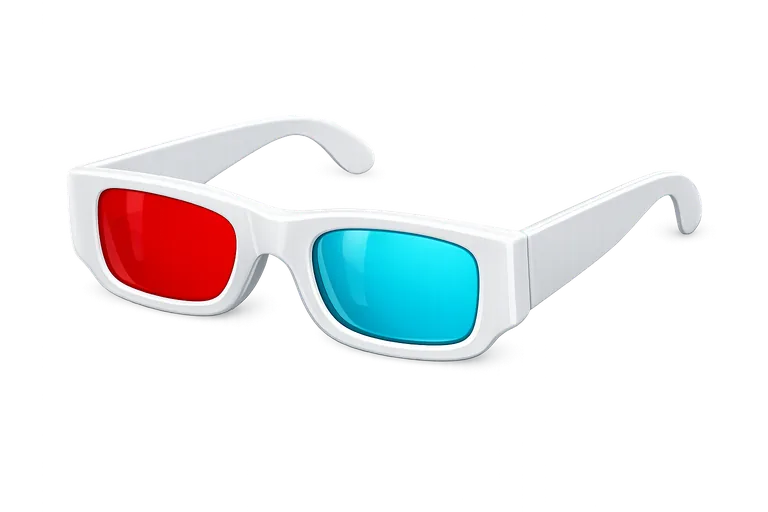
A common low-cost way to show different images to each eye is anaglyph glasses: one lens is red, the other blue (or cyan). On a screen with a dark background, a red object is visible through the red filter and blocked by the blue filter, and a blue object is the other way round. Drawing some objects in red and others in blue is therefore enough to give each eye its own picture.
In ZyncView the red filter goes on the left eye and the blue filter on the right eye, in every game. Because glasses and screens differ, each player calibrates first: you lower the brightness of each colour until it is just invisible through the "wrong" filter, which reduces "crosstalk" between the eyes. The at-home guide walks through it.
How ZyncView's games work
ZyncView is a wellness and entertainment product. These are its game rules, not medical claims.
- Two colour channels. In Tank Shooter and Truck Driver, the object you control is drawn in one colour and the things you must react to in the other, so the task needs both eyes.
- Brightness balance. At the start you tell the game which eye feels stronger and which feels weaker. This is your own impression, not a test. During play the brightness balance between the two pictures changes in steps, so the game gets harder as you do well. The level where a session ends is saved as a game score.
- Colours swap. At regular intervals the two colours swap roles with a brief flash, so neither eye always has the same job.
- Clear end conditions. A session ends after three misses (shooter) or three collisions (truck driver).
- Reading exercises. Reading therapy alternates red and blue lines (or words) of a short story, so both eyes take turns.
- A suggested routine. The app suggests a daily routine of play, and a coach in a school or community team can adjust it. The daily page shows how much you have played against it.
What the research says
Dichoptic and binocular games have been tested in several studies, with mixed results. In short:
- A small study of 50 preschool children (3 to under 7 years) found visual acuity improved after 4 weeks of binocular iPad games, more than in a small sham-game group [4].
- The largest trial so far, in 385 children aged 5 to 12, compared 16 weeks of a binocular iPad game (1 hour a day) with patching (2 hours a day). Acuity improved by 1.05 lines with the game and 1.35 lines with patching, so the game did not meet the trial's "not worse than patching" limit. Only 22% of children in the game group completed more than 75% of the prescribed treatment [2].
- In 138 children aged 7 to 12, most of whom had already been treated, 4 to 8 weeks of a binocular game plus glasses was no different from continued glasses alone [3].
- A dichoptic headset therapy (Luminopia One) improved acuity by 1.8 lines over 12 weeks versus 0.8 lines with glasses alone in 105 children aged 4 to 7 [8]. The US FDA authorized it for that age group in 2021; it is not ZyncView.
- A Cochrane review found only one eligible trial comparing binocular treatment with patching in children aged 3 to 8 and judged the results likely comparable at 16 weeks, with limited evidence overall [9].
Read the details, including the limits of each study, in our full research review. The key points: these studies tested specific iPad games, not ZyncView; results may not carry over to other software, ages or durations; and adherence (actually playing as prescribed) was a major issue.
Limits and safety
- Dichoptic games are not a proven replacement for glasses, patching or atropine. If you have an eye condition, talk to your eye doctor first, especially for a child.
- Stop and speak to an eye care professional if you get headaches, eye strain that does not settle, or double vision.
- ZyncView is not a medical device and has not published results of its own trials. Nothing on this site should be read as a promise of any health benefit.
References
- National Eye Institute. Amblyopia (Lazy Eye). Last updated 26 Nov 2024. Source
- Holmes JM, Manh VM, Lazar EL, et al.; Pediatric Eye Disease Investigator Group. Effect of a binocular iPad game vs part-time patching in children aged 5 to 12 years with amblyopia: a randomized clinical trial. JAMA Ophthalmology 2016;134:1391-1400. DOI · PubMed 27812703
- Pediatric Eye Disease Investigator Group; Holmes JM, Manny RE, Lazar EL, et al. A randomized trial of binocular Dig Rush game treatment for amblyopia in children aged 7 to 12 years. Ophthalmology 2019;126:456-466. DOI · PubMed 30352226
- Birch EE, Li SL, Jost RM, et al. Binocular iPad treatment for amblyopia in preschool children. Journal of AAPOS 2015;19:6-11. DOI · PubMed 25727578
- Xiao S, Angjeli E, Wu HC, et al.; Luminopia Pivotal Trial Group. Randomized controlled trial of a dichoptic digital therapeutic for amblyopia. Ophthalmology 2022;129:77-85. DOI · PubMed 34534556
- Tailor V, Ludden S, Bossi M, Bunce C, Greenwood JA, Dahlmann-Noor A. Binocular versus standard occlusion or blurring treatment for unilateral amblyopia in children aged three to eight years. Cochrane Database of Systematic Reviews 2022, CD011347. DOI · PubMed 35129211